

Related content
- Oct 07, 2026Sunwin Aerospace Power System Testing SolutionAn aerospace power system generates, stores, converts, regulates and distributes electrical energy, and is typically divided into primary power and secondary power. Secondary power converts primary power into another form or specification to meet the requirements of different onboard electrical equipment. As an essential support system, the aerospace power system provides safe and reliable energy for every subsystem of aircraft and spacecraft, and its development level plays a decisive role in improving aircraft performance and extending service life.
From 28Vdc, 270Vdc to 400Hz AC supplies, power quality directly affects the safe operation of onboard equipment. International aerospace power quality standards such as MIL-STD-704 and RTCA DO-160 impose strict requirements on voltage, frequency and transient characteristics. Therefore, comprehensive testing and evaluation of the power system under defined operating conditions is of great significance. - Oct 06, 2026Sunwin Advantages Technology, Products and Service — A Trusted Partner in Power TestingWith leading liquid-cooling technology, a complete product portfolio, precise real-working-condition simulation, one-stop solutions, international quality certification and a customer-first service philosophy, Sunwin will continue to safeguard the safety and reliability of power systems and AI computing infrastructure worldwide. Contact us and start a trustworthy partnership in power testing today.
- Oct 04, 2026Why Sunwin? Your Professional Partner in Power Testing & MeasurementQingdao Sunwin Technologies Co., Ltd. (Sunwin) is a professional enterprise dedicated to the R&D, manufacturing and service of intelligent power testing equipment. Built on load banks, Sunwin provides testing systems and intelligent test equipment for the generation, transmission, transformation, control and utilization of electrical energy.
A load bank is a power testing device that simulates real operating conditions (a dummy load). It reproduces the load characteristics of power equipment through resistive, inductive and other elements, enabling testing, adjustment, calibration and verification of generator sets, UPS, batteries and other power sources without connecting them to real loads. With advanced load testing technology, Sunwin helps customers scientifically verify the performance and reliability of power equipment, improve quality control and reduce safety accidents and economic losses caused by power failures. - Oct 03, 2026Sunwin WN-6000L 6000kVA Resistive-Inductive Load BankThe Sunwin WN-6000L is a 6000kVA high-power resistive-inductive (R/L) load bank developed by Qingdao Sunwin Technologies Co., Ltd. (Sunwin). Designed for generator load bank testing, UPS load bank testing, data center load testing and power-system tests, it delivers controlled active and lagging reactive loading to fully meet high-power equipment load-verification requirements.
Built on the core principle of "resistive-inductive integration", the WN-6000L combines 4800kW active load with 3600kVar inductive reactive load at 0.8 lagging power factor, accurately reproducing the real operating conditions of generator sets and UPS systems. It helps customers fully verify load capacity and reliability during factory acceptance, grid-connection testing and routine maintenance.
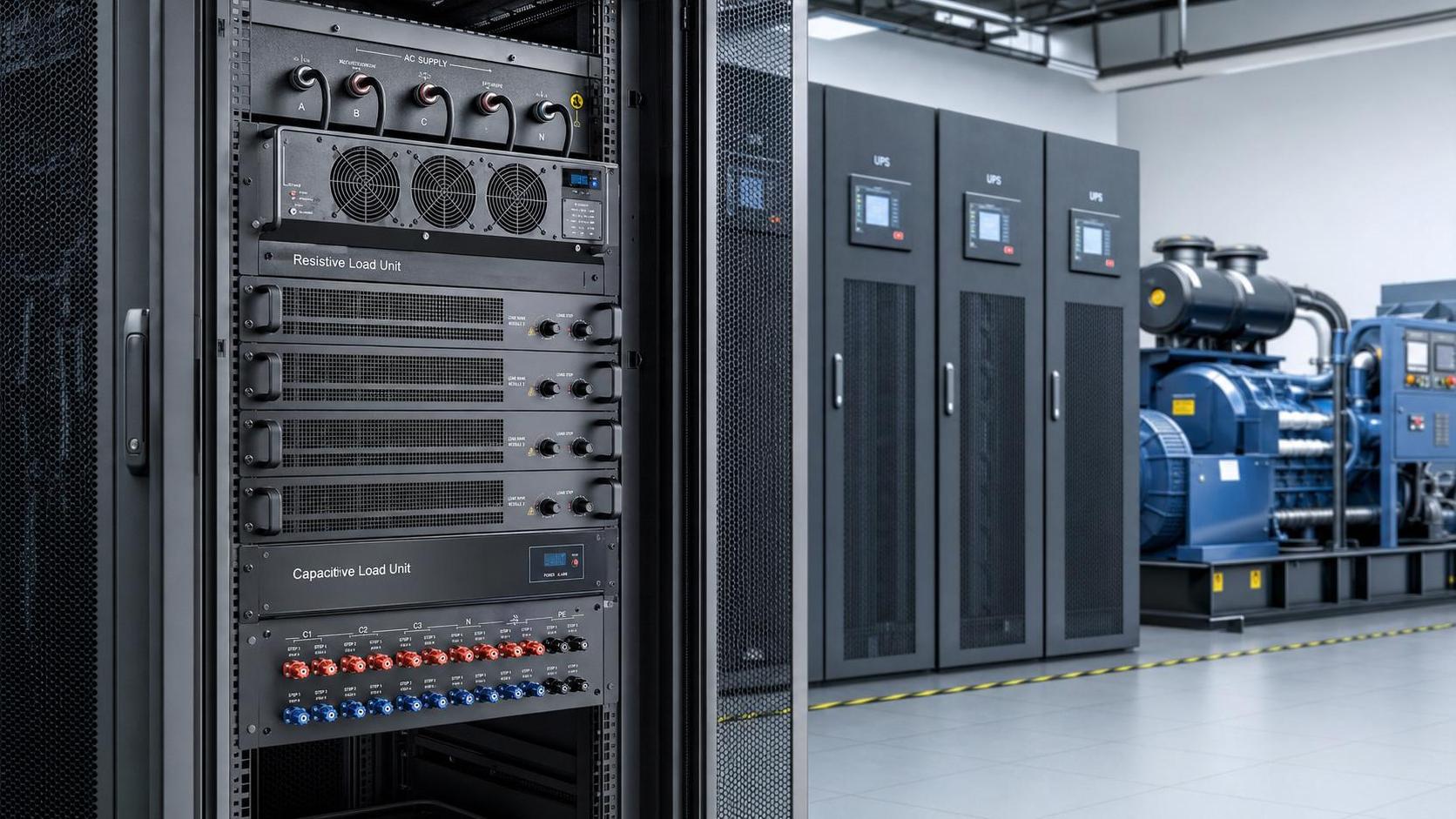
Rack Mounted Load Bank Sizing Guide for Data Center Backup Testing
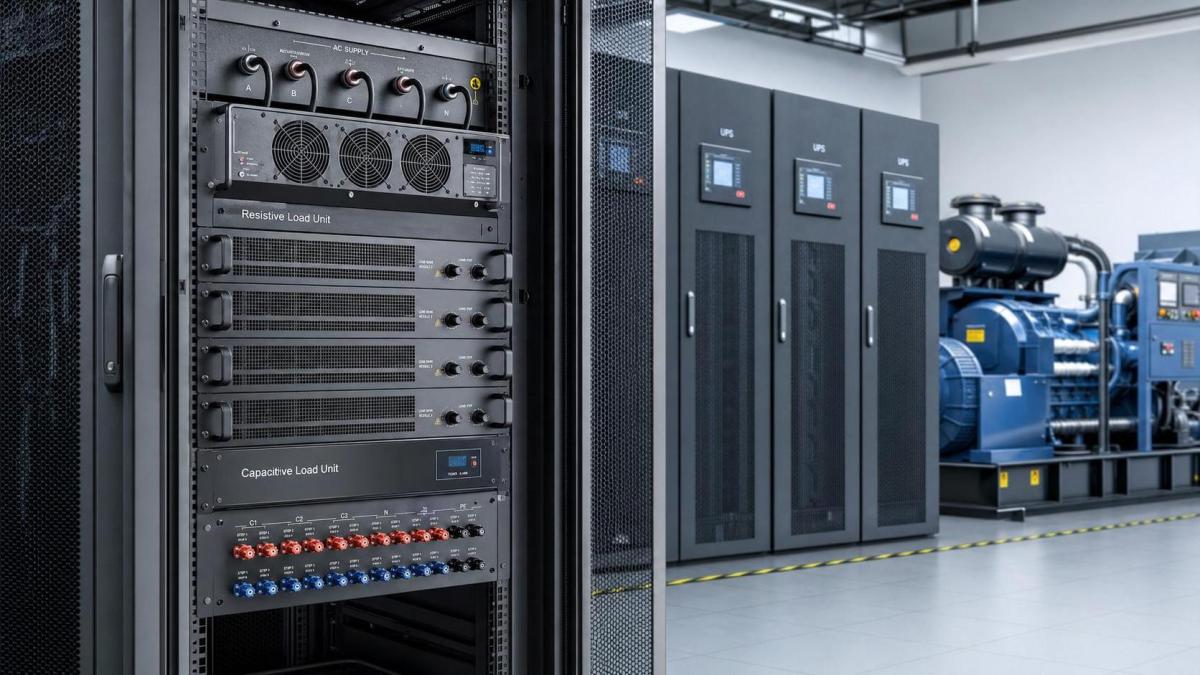
Choosing the right Rack Mounted Load Bank is critical for accurate data center backup testing, safe commissioning, and reliable capacity verification.
For data center backup systems, sizing is not just about matching a nameplate number.
It directly affects generator stability, UPS performance, airflow behavior, and the quality of acceptance testing.
A well-sized Rack Mounted Load Bank helps verify true capacity under controlled conditions.
It also reveals weak points before a real outage forces the issue.
This matters during factory acceptance, site commissioning, periodic maintenance, and expansion planning.
In practical terms, proper selection starts with the test objective, then moves to electrical, thermal, and installation limits.
Why Rack Mounted Load Bank Sizing Matters
A backup system can look adequate on paper and still fail under a realistic test profile.
That is why Rack Mounted Load Bank sizing should reflect the actual operating environment.
If the load bank is undersized, the test may miss overload behavior or transient instability.
If it is oversized without usable step control, test resolution becomes poor and control is less practical.
A correctly selected Rack Mounted Load Bank supports several goals at once:
- Validate generator output across expected load bands.
- Confirm UPS bypass and battery discharge behavior.
- Check thermal response inside racks and hot aisle zones.
- Measure control stability during step loading.
- Create repeatable records for compliance and maintenance review.
From a selection standpoint, the best unit is not simply the biggest one.
It is the Rack Mounted Load Bank that matches test depth, power architecture, and cooling conditions with minimal compromise.
Start with the Real Test Scope
Sizing becomes easier when the test purpose is clearly defined.
Different backup tests call for different Rack Mounted Load Bank capacities and control features.
Common backup testing scenarios
- Generator commissioning: often needs 25%, 50%, 75%, and 100% loading steps.
- UPS runtime verification: focuses on discharge duration, voltage behavior, and transfer performance.
- Integrated system testing: combines generator, UPS, ATS, and cooling response.
- Expansion assessment: checks if future rack density can be supported safely.
This also means one data center may need more than one test profile across its lifecycle.
A Rack Mounted Load Bank selected only for a single commissioning event may be too limited later.
That is where modularity, step granularity, and scalable control become important evaluation points.
Core Sizing Factors to Calculate First
Before comparing models, define the electrical baseline with real operating numbers.
1. Required kW capacity
Start from the rated output of the system being tested, not from estimated IT demand alone.
For generator testing, target capacity is often close to full rated kW.
For UPS or branch validation, a partial-load Rack Mounted Load Bank may be sufficient.
2. Voltage and phase configuration
Match the load bank to site voltage, frequency, and single-phase or three-phase architecture.
A mismatch here creates unnecessary adapters, reduced performance, or unsafe installation work.
3. Step resolution
Fine step control helps simulate realistic load growth and observe control response more accurately.
For example, 5 kW or 10 kW steps are often more useful than very large increments.
4. Duty cycle and test duration
Short commissioning tests and long endurance tests place different stress on the equipment.
The Rack Mounted Load Bank must support the intended duty cycle without thermal derating.
5. Redundancy structure
N, N+1, and 2N systems require different test logic.
You may need one Rack Mounted Load Bank per path, or a flexible unit that can be redistributed.
Thermal and Mechanical Limits Often Decide the Final Choice
Electrical sizing gets most of the attention, but installation constraints are often the real filter.
A Rack Mounted Load Bank must fit the rack, airflow pattern, and service access requirements.
Key physical checks
- Available rack units and weight loading limits.
- Front-to-rear or side airflow direction.
- Ambient temperature during full-load testing.
- Cable entry, breaker access, and maintenance clearance.
- Noise level in occupied technical spaces.
In dense white-space environments, heat rejection needs careful review.
A high-capacity Rack Mounted Load Bank can add significant thermal load to the room.
That is one reason some sites compare rack-mounted units with liquid cooling load bank options.
For compact indoor testing, thermal management can be as important as power rating.
How to Compare Specifications Without Missing Risk
Specification sheets often look similar, yet real operating value can differ a lot.
A disciplined review of each Rack Mounted Load Bank helps prevent avoidable surprises.
Protection should include overtemperature response, airflow monitoring, emergency stop, and clear status indication.
For repeat testing programs, data capture and remote control save time and reduce operator exposure.
That becomes more valuable as test frequency increases across multiple halls or backup paths.
A Practical Selection Path for Better Decisions
A practical process usually produces better results than comparing product names first.
- Define the exact asset to be tested and the acceptance criteria.
- List rated kW, voltage, phase, frequency, and redundancy mode.
- Set the needed load steps, duration, and monitoring points.
- Review rack space, cooling path, and site access limitations.
- Compare at least two Rack Mounted Load Bank configurations against the same checklist.
- Confirm expansion margin for future testing, not just current demand.
For many projects, a resistive load bank is the most direct choice for backup power verification.
Sunwin focuses on manufacture of resistive load bank systems, Rack Mounted Load Bank solutions, electronics load bank units, liquid cooling load bank models, portable load bank products, battery load tester equipment, grounding resistor cabinet systems, and capacitor bank solutions.
That range is useful when the application starts with rack testing but later expands into batteries or thermal constraints.
The key is to size the Rack Mounted Load Bank around the test requirement, not around a generic catalog category.
When sizing is done carefully, backup testing becomes more accurate, safer to execute, and more valuable for future planning.
A solid decision usually comes from combining electrical fit, thermal realism, and clear operational intent into one selection standard.


Please give us a message
