

Related content
- Oct 04, 2026Why Sunwin? Your Professional Partner in Power Testing & MeasurementQingdao Sunwin Technologies Co., Ltd. (Sunwin) is a professional enterprise dedicated to the R&D, manufacturing and service of intelligent power testing equipment. Built on load banks, Sunwin provides testing systems and intelligent test equipment for the generation, transmission, transformation, control and utilization of electrical energy.
A load bank is a power testing device that simulates real operating conditions (a dummy load). It reproduces the load characteristics of power equipment through resistive, inductive and other elements, enabling testing, adjustment, calibration and verification of generator sets, UPS, batteries and other power sources without connecting them to real loads. With advanced load testing technology, Sunwin helps customers scientifically verify the performance and reliability of power equipment, improve quality control and reduce safety accidents and economic losses caused by power failures. - Oct 03, 2026Sunwin WN-6000L 6000kVA Resistive-Inductive Load BankThe Sunwin WN-6000L is a 6000kVA high-power resistive-inductive (R/L) load bank developed by Qingdao Sunwin Technologies Co., Ltd. (Sunwin). Designed for generator load bank testing, UPS load bank testing, data center load testing and power-system tests, it delivers controlled active and lagging reactive loading to fully meet high-power equipment load-verification requirements.
Built on the core principle of "resistive-inductive integration", the WN-6000L combines 4800kW active load with 3600kVar inductive reactive load at 0.8 lagging power factor, accurately reproducing the real operating conditions of generator sets and UPS systems. It helps customers fully verify load capacity and reliability during factory acceptance, grid-connection testing and routine maintenance. - Sep 27, 2026WN-5000L 5000kVA Resistive-Inductive Load BankThe WN-5000L is a 5000kVA high-power resistive-inductive (R/L) load bank developed by Qingdao Sunwin Technologies Co., Ltd. (Sunwin). Designed for generator load bank testing, UPS load bank testing, data center load testing and power-system tests, it delivers controlled active and lagging reactive loading to fully meet power equipment load-verification requirements.
Built on the core principle of "resistive-inductive integration", the WN-5000L combines 4000kW active load with 3000kVar inductive reactive load at 0.8 lagging power factor, accurately reproducing the real operating conditions of generator sets and UPS systems. It helps customers fully verify load capacity and reliability during factory acceptance, grid-connection testing and routine maintenance. - Oct 05, 2026Sunwin 100kW Portable Resistive Load BankThe Sunwin 100kW Portable Resistive Load Bank is a cost-effective dummy load device designed for generator load testing, UPS load testing and emergency power testing. Built around a 100kW resistive load, it helps users quickly and reliably verify the load capacity and performance of power equipment on site by simulating real operating conditions.
Featuring a portable structure and forced-air cooling, the unit can be flexibly deployed in power plants, data centers, telecom base stations, shipyards and construction sites, making it a common testing tool for generator factory loaded verification, on-site commissioning and routine maintenance. With step loading and digital metering, it delivers high load accuracy and intuitive operation, making power testing simpler and more professional.
Many teams compare price, kW rating, and lead time first.
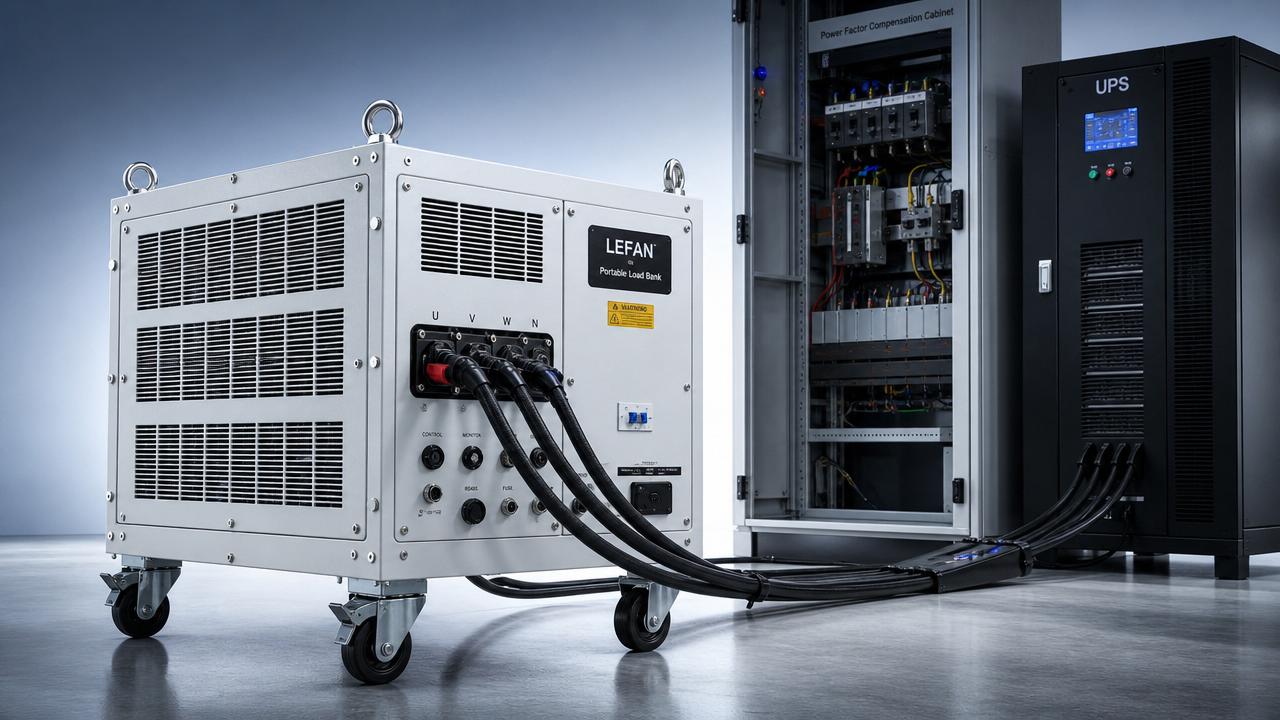
Yet a Portable Load Bank can still fail the project if key details were ignored before ordering.
Mobility, heat dissipation, control logic, resistor design, and site conditions all shape actual test performance.
For resistive and capacitor-related power systems, choosing the right Portable Load Bank reduces commissioning risk, protects assets, and avoids costly rework.
What is often misunderstood about a Portable Load Bank?
A Portable Load Bank is not only a power absorber with handles or wheels.
It is a test tool that must match electrical behavior, cooling demand, transport limits, and on-site operating conditions.
Many buyers assume nameplate capacity tells the whole story.
In practice, continuous duty, step resolution, airflow path, and voltage range matter just as much.
For example, two Portable Load Bank models may both be rated at 100kW.
One may support fine step loading and long-duration testing, while the other suits only short tests in cleaner indoor environments.
This difference becomes critical when testing generators, UPS systems, battery strings, capacitor-supported circuits, or DC power platforms.
Key point to verify before ordering
- Rated power under real ambient temperature
- Voltage and frequency compatibility
- Load step size and control accuracy
- Continuous or intermittent duty cycle
- Indoor, outdoor, or mixed-site protection level
Why do mobility details matter more than buyers expect?
The word portable creates false confidence.
A Portable Load Bank may be movable, but not necessarily easy to deploy across actual job sites.
Weight, wheel design, lifting points, cable entry direction, and footprint affect daily use.
A unit that fits a warehouse floor may be difficult on ramps, gravel, rooftop areas, or narrow electrical rooms.
Transport vibration is another hidden issue.
Poorly secured resistor elements, contactors, or fan assemblies can loosen during repeated movement.
That risk grows when the Portable Load Bank travels between service vehicles and temporary test points.
Questions that reveal true portability
- Can one person position it safely, or are two needed?
- Are casters locked and rated for full operating weight?
- Does the enclosure pass through standard doors and lifts?
- Are lifting eyes certified for repeated hoisting?
- Can cables connect without blocking airflow or access panels?
Sunwin designs resistive load bank solutions with practical deployment in mind.
That matters when a Portable Load Bank must serve changing test locations instead of one fixed bay.
How do cooling and resistor design affect test reliability?
This is one of the most overlooked parts of Portable Load Bank selection.
A resistive load bank converts electrical energy into heat.
If airflow is weak or uneven, internal temperature rises fast and usable power may drop.
Fan redundancy, air channel layout, and temperature protection define long-term stability.
Resistor material also matters.
Different resistor structures influence heat distribution, oxidation resistance, response speed, and service life.
In dusty or humid environments, poor enclosure ventilation may pull contamination into hot zones.
That can shorten component life and distort test stability.
Cooling details worth checking
- Airflow direction and minimum clearance requirements
- Fan power source and failure alarm logic
- Overtemperature shutdown threshold
- Resistor alloy type and corrosion resistance
- Derating curve at high ambient temperature
If the test involves long runs, ask for thermal data rather than only nominal specifications.
A Portable Load Bank that runs hotter than expected may interrupt the schedule or create safety issues.
Which control and monitoring features should be specified early?
Control architecture changes how useful a Portable Load Bank becomes after delivery.
Manual switches may work for basic tests, but automated sequences are often needed for modern commissioning.
Remote control supports safer operation when heat, noise, or energized equipment limits operator access.
Data logging is equally important.
Without recorded voltage, current, power, and temperature trends, post-test verification becomes weak.
That can be a problem in generator acceptance, battery discharge testing, or UPS maintenance records.
Useful control options for a Portable Load Bank
- Local touch panel or rugged push-button control
- Remote handheld station or PC interface
- Programmable load step sequences
- Alarm history and event records
- Communication protocols for site integration
It is better to define these functions before production.
Late changes often affect panel layout, wiring, software logic, and delivery time.
What site risks can make the wrong Portable Load Bank expensive?
Mismatch usually appears on site, not on the quotation sheet.
Common problems include insufficient cable length, wrong connectors, limited ventilation space, and unsuitable inlet orientation.
Noise can also become a hidden cost.
High airflow fans may be acceptable outdoors but difficult near offices, hospitals, or enclosed data rooms.
Environmental protection should not be guessed.
If the Portable Load Bank will face rain, salt air, dust, or high humidity, enclosure treatment and component sealing matter.
For projects tied to battery systems, capacitor banks, or grounding resistor cabinets, compatibility with surrounding equipment is essential.
Testing windows are often short, so even a small mismatch can delay energization.
Practical pre-order checklist
How can buyers compare options without focusing only on price?
A cheaper Portable Load Bank may cost more over its service life.
Frequent fan replacement, unstable contactors, poor paint protection, or limited support can increase downtime quickly.
Compare total value instead of invoice price alone.
This is especially true when the unit will support repeated commissioning, maintenance testing, or rental-style use.
Smart comparison factors
- Electrical accuracy and load step flexibility
- Thermal protection and component durability
- Ease of transport and setup time
- Documentation, drawings, and test reports
- Availability of after-sales support and spare parts
Sunwin manufactures resistive load bank products, rack mounted load bank units, electronics load bank systems, liquid cooling load bank designs, Portable Load Bank solutions, battery load testers, grounding resistor cabinets, and capacitor bank equipment.
That broader product background helps when one project touches multiple power testing and protection needs.
FAQ summary: what should be confirmed before the final order?
Before ordering a Portable Load Bank, go beyond headline specifications.
Review mobility, resistor construction, airflow design, control functions, and site realities with equal attention.
A well-matched Portable Load Bank improves test accuracy, safety, and long-term ownership value.
If project conditions are already defined, prepare a checklist of electrical data, site limits, and control needs before requesting the final quotation.
That simple step usually prevents the most expensive mistakes.


Please give us a message
