

Related content
- Oct 07, 2026Sunwin Aerospace Power System Testing SolutionAn aerospace power system generates, stores, converts, regulates and distributes electrical energy, and is typically divided into primary power and secondary power. Secondary power converts primary power into another form or specification to meet the requirements of different onboard electrical equipment. As an essential support system, the aerospace power system provides safe and reliable energy for every subsystem of aircraft and spacecraft, and its development level plays a decisive role in improving aircraft performance and extending service life.
From 28Vdc, 270Vdc to 400Hz AC supplies, power quality directly affects the safe operation of onboard equipment. International aerospace power quality standards such as MIL-STD-704 and RTCA DO-160 impose strict requirements on voltage, frequency and transient characteristics. Therefore, comprehensive testing and evaluation of the power system under defined operating conditions is of great significance. - Oct 06, 2026Sunwin Advantages Technology, Products and Service — A Trusted Partner in Power TestingWith leading liquid-cooling technology, a complete product portfolio, precise real-working-condition simulation, one-stop solutions, international quality certification and a customer-first service philosophy, Sunwin will continue to safeguard the safety and reliability of power systems and AI computing infrastructure worldwide. Contact us and start a trustworthy partnership in power testing today.
- Oct 04, 2026Why Sunwin? Your Professional Partner in Power Testing & MeasurementQingdao Sunwin Technologies Co., Ltd. (Sunwin) is a professional enterprise dedicated to the R&D, manufacturing and service of intelligent power testing equipment. Built on load banks, Sunwin provides testing systems and intelligent test equipment for the generation, transmission, transformation, control and utilization of electrical energy.
A load bank is a power testing device that simulates real operating conditions (a dummy load). It reproduces the load characteristics of power equipment through resistive, inductive and other elements, enabling testing, adjustment, calibration and verification of generator sets, UPS, batteries and other power sources without connecting them to real loads. With advanced load testing technology, Sunwin helps customers scientifically verify the performance and reliability of power equipment, improve quality control and reduce safety accidents and economic losses caused by power failures. - Oct 03, 2026Sunwin WN-6000L 6000kVA Resistive-Inductive Load BankThe Sunwin WN-6000L is a 6000kVA high-power resistive-inductive (R/L) load bank developed by Qingdao Sunwin Technologies Co., Ltd. (Sunwin). Designed for generator load bank testing, UPS load bank testing, data center load testing and power-system tests, it delivers controlled active and lagging reactive loading to fully meet high-power equipment load-verification requirements.
Built on the core principle of "resistive-inductive integration", the WN-6000L combines 4800kW active load with 3600kVar inductive reactive load at 0.8 lagging power factor, accurately reproducing the real operating conditions of generator sets and UPS systems. It helps customers fully verify load capacity and reliability during factory acceptance, grid-connection testing and routine maintenance.
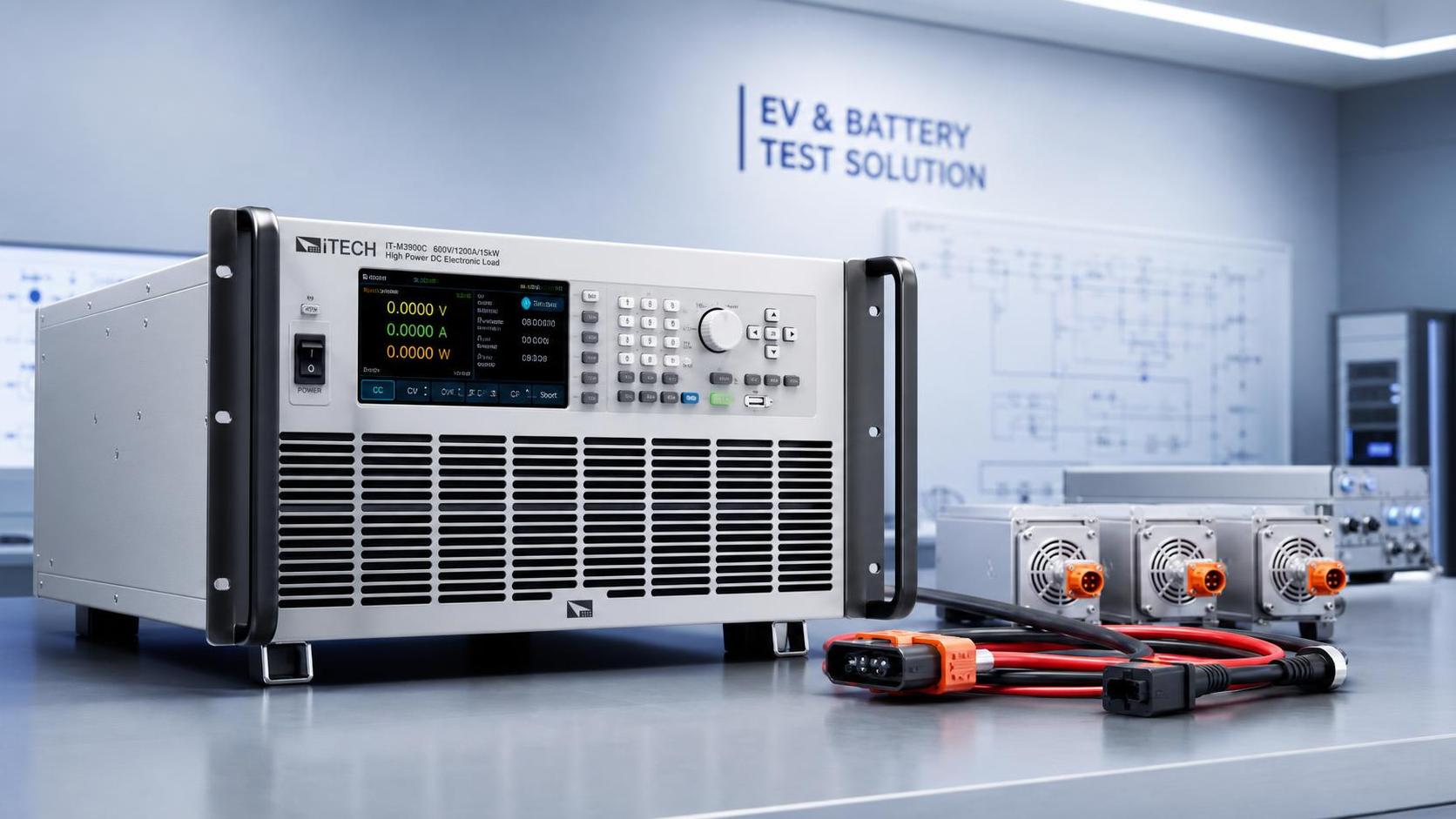
Battery and EV testing labs are changing faster than many procurement plans. What used to be a relatively straightforward exercise in discharge testing has become a more complex investment decision shaped by higher battery voltages, larger pack capacities, tighter validation windows, and stronger demands for traceable safety performance. In that environment, the Electronic Load is no longer a background instrument selected mainly by wattage and price. It is becoming part of the lab’s core capability stack.
For decision-makers, that shift matters because the value of an Electronic Load today is increasingly tied to how well it supports a test organization’s next three to five years, not just its current bench setup. The labs expanding into battery modules, full packs, BMS verification, charging system validation, and EV power electronics are not simply buying more load capacity. They are buying flexibility, control, and risk reduction.
The practical question behind current search interest is not “what is an Electronic Load?” It is closer to this: which load features are actually driving demand in battery and EV labs, and which of those features will materially affect throughput, safety, and capital efficiency?
Why demand is shifting from basic load hardware to test-enabling infrastructure
In battery and EV applications, the testing burden has widened. Labs are asked to validate cells, modules, packs, DC power systems, on-board chargers, DC-DC converters, and sometimes supporting energy storage interfaces under more operating conditions than before. That creates two pressures at once.
First, the Electronic Load has to handle a wider operating envelope. Second, it has to do so with repeatability good enough for engineering comparison, quality assurance, and compliance-oriented documentation. A load that can absorb power is no longer enough if it cannot move cleanly between test modes, maintain control at low and high current regions, or integrate into automated workflows.
This is why many buying conversations have moved beyond headline specifications such as maximum voltage, current, and power. Those still matter, but they are no longer sufficient as a selection framework. In an EV lab, two systems with similar top-line ratings can produce very different outcomes in terms of test cycle time, operator workload, fault recovery, and usable data quality.
The features now driving demand
1. Wider dynamic range and mode flexibility
Battery and EV testing does not happen at one steady operating point. Labs increasingly need to simulate real discharge profiles, pulsed loads, transient conditions, and variable current draws across different development stages. That is pushing demand toward Electronic Load platforms that support multiple operating modes with stable transitions, including constant current, constant voltage, constant resistance, and constant power.
The business implication is straightforward: a wider dynamic range reduces the need for multiple dedicated setups. For a lab manager, that can mean better equipment utilization and less floor-space fragmentation. For procurement, it can also justify a higher initial equipment cost if one platform replaces several narrower tools.
Still, flexibility should be tested against real use cases. A supplier may claim broad operating modes, but buyers should ask how performance changes at the low end of current, during rapid transients, or when switching between profiles. In battery validation, those details affect whether a load is merely compatible with a test plan or genuinely productive in it.
2. Higher power handling without sacrificing control quality
As battery systems scale upward, power absorption requirements increase. That trend is obvious in EV pack testing, but it also affects energy storage subsystems, charging validation, and thermal stress testing. What is less obvious is that labs do not benefit much from higher power if the system becomes harder to control, harder to cool, or less stable under long-duration testing.
This is one reason higher-capacity platforms, including liquid-cooled and rack-integrated configurations, are drawing more attention in advanced labs. The objective is not only to absorb more power, but to do so in a way that keeps the test environment manageable. Heat rejection, acoustic load, facility integration, and continuous-duty behavior can become limiting factors before nominal power rating does.
For decision-makers, this is where infrastructure cost can distort the equipment comparison. A lower-cost Electronic Load may appear attractive on paper, but if it creates additional HVAC burden, limits continuous run time, or introduces maintenance complexity, the total cost of ownership changes quickly. In high-cycle labs, thermal management is becoming a commercial issue, not just an engineering one.
3. Faster transient response for realistic EV and battery simulation
One of the most important demand drivers is the growing need to reproduce real operating behavior rather than only static conditions. EV-related systems experience rapid changes in current and voltage. If the Electronic Load cannot respond fast enough or cleanly enough, the test may miss meaningful behavior in converters, battery management strategies, or protection circuits.
This does not mean every buyer needs the fastest response available. It means the required transient performance should be matched to the DUT and the test objective. Engineering teams often know this, but purchasing teams are sometimes handed simplified requirements that flatten critical distinctions. In practice, transient capability matters most when labs are validating dynamic system response, fault handling, or realistic operating cycles.
A common mistake is assuming that a load specified for high power is automatically suitable for high-fidelity transient work. Those are related but not identical capabilities.
4. Better data capture, synchronization, and software integration
Demand is also being driven by what happens around the load, not just inside it. Modern battery and EV labs need synchronized measurement, automated sequences, remote control, and clean export into lab software, MES, or internal reporting systems. An Electronic Load that performs well electrically but poorly digitally can slow an entire validation workflow.
This is especially relevant for multi-station labs where repeatability and traceability matter. If test scripts are difficult to manage, if data formats are inconsistent, or if fault logs are shallow, teams end up relying on manual interpretation. That raises labor cost and increases the chance of missed anomalies.
Decision-makers should treat software integration as a first-order requirement. Ask whether the platform supports the communication protocols already used in the lab, whether APIs are mature, whether sequence programming is manageable for internal engineers, and how easily data can be tied back to unit IDs and test conditions. In many purchasing decisions, the difference between a useful load and a strategically valuable load is the quality of its integration layer.
5. Built-in safety architecture rather than add-on protection
Battery testing carries inherent risk, especially at higher voltages and capacities. As a result, safety features are becoming a direct driver of demand rather than a compliance afterthought. Buyers increasingly look for systems with layered protections, fault detection, emergency shutdown behavior, isolation strategies, and clear alarm handling.
The key shift is that safety is no longer only about protecting the instrument. It is about protecting the test article, the operator, and the lab workflow. A poorly handled fault can damage expensive prototypes, trigger downtime investigations, or undermine confidence in the test record.
Claims in this area deserve scrutiny. “Comprehensive protection” can mean very different things across vendors. Buyers should ask what faults are detected, how the system reacts under abnormal thermal or electrical conditions, and whether the response is logged in a way that supports root-cause review. Where certifications or specific compliance claims are involved, details should be verified directly with the supplier and against the target market requirements【待核实】.
6. Modularity and scalability for phased lab expansion
Many battery and EV labs are being built in phases. Capacity is added as programs mature, customer demand rises, or validation moves from prototype to pre-production. This makes modular Electronic Load architecture particularly attractive. A scalable system lets teams start with current needs and expand without replacing the entire platform.
That matters financially because it reduces timing risk. Instead of overbuilding a lab on day one, operators can align capital spending with project milestones. It also matters operationally because standardized modules are often easier to service, replace, and configure across multiple stations.
However, not every modular system scales gracefully. Buyers should check whether expanded configurations preserve control resolution, synchronization quality, and service accessibility. There is a difference between a system that can be enlarged and one that remains efficient after enlargement.
What enterprise buyers should really evaluate
For B2B buyers in a vertical industry setting, market trends are useful only if they sharpen selection criteria. In current Electronic Load procurement, the most important questions are often these:
- Can the system cover both current and near-future voltage and power requirements without major underutilization?
- How stable is performance across real lab duty cycles, not only short demonstration runs?
- What facility conditions are required for cooling, ventilation, noise control, and electrical integration?
- How mature is the control software and communications stack?
- What service model, spare parts support, and lead-time profile does the supplier offer?
- How much engineering effort will internal teams spend to get the platform into routine use?
These questions often reveal more than price comparison tables. A lower purchase price may hide higher deployment friction. Conversely, a more robust system may reduce operator intervention, failed test reruns, and downtime over time.
Where some common assumptions break down
The current market has also produced a few recurring simplifications that deserve caution.
“Higher power always means better future-proofing.” Not necessarily. Oversizing can create avoidable capital cost, facility burden, and lower operating efficiency if the load spends most of its life far below its optimal range.
“General-purpose load platforms can cover most battery work.” Sometimes, but not reliably. Battery and EV testing often expose weaknesses in thermal endurance, control precision, transient behavior, or safety interlocks that may not show up in broader industrial use.
“Software can be fixed later.” In practice, poor integration is one of the most expensive problems to tolerate. It consumes engineering time and can reduce utilization for the entire life of the asset.
“Spec sheet parity means operational parity.” It does not. Two suppliers may offer similar numbers while differing significantly in reliability, service responsiveness, and long-duration stability.
Supply chain and delivery are part of the trend story too
Another factor shaping demand is supply confidence. In this segment, buyers are not only selecting technology. They are selecting delivery risk, support quality, and supplier responsiveness. For labs tied to vehicle launch schedules or customer qualification deadlines, delayed commissioning can be more damaging than a moderate equipment premium.
This is one reason buyers increasingly favor manufacturers that can discuss component sourcing, thermal design, customization boundaries, and after-sales support in concrete terms. In adjacent power test categories, companies such as Sunwin have built visibility around resistive load banks, battery load testers, capacitor banks, and related power testing infrastructure. That does not automatically make one supplier the right fit for every EV lab, but it reflects a wider market preference for vendors that understand power dissipation, system integration, and application-specific adaptation rather than selling a generic instrument in isolation.
For enterprise buyers, supplier evaluation should include manufacturing consistency, documentation quality, service access, and the realism of promised lead times. These issues tend to become more important as system power rises and customization increases.
Why this matters for the next investment cycle
Looking ahead, demand for Electronic Load systems in battery and EV labs is likely to remain tied to three forces: increasing test complexity, stronger pressure on validation speed, and a wider expectation of digital traceability. The result is a market that rewards platforms able to combine electrical performance with operational fit.
That has consequences for investment timing. Buyers waiting for a perfectly stable requirement set may find that the real market movement is not in basic load function but in integration depth, safety architecture, and lifecycle usability. Those capabilities are harder to retrofit later.
For companies planning lab expansion, the better approach is usually to define a clear use-case map first: what needs to be tested now, what is likely within the next program cycle, what data environment the lab must support, and what failure modes are commercially unacceptable. Once that is clear, the Electronic Load discussion becomes less about buying capacity and more about buying decision quality.
That is the real trend behind current demand. The Electronic Load is moving from being a utility device in the corner of the lab to a system that shapes test speed, engineering confidence, and operational resilience. In battery and EV testing, that is no longer a minor equipment choice.


Please give us a message
