

Related content
- Oct 19, 2026Sunwin 60kW AC Liquid-Cooled Resistive Load BankExplore Sunwin's 60kW AC liquid-cooled resistive load bank for UPS, generator and data center testing. Its compact 10U rack design supports continuous operation, low-noise cooling and independent three-phase step loading.
- Oct 18, 2026Sunwin WN-500L 500kW AC Liquid-Cooled Resistive Load BankThe Sunwin WN-500L is a 500kW AC liquid-cooled resistive load bank designed for data centers, providing controlled load testing for three-phase AC power supplies. Its core advantage lies in its innovative liquid cooling system, which enables stable operation at full rated power while minimizing heat dissipation and noise in the test environment — making it ideal for indoor test facilities where traditional air-cooled solutions are impractical or difficult to deploy.
With pure resistive loading for high-precision power absorption, an on-board HMI touch screen, PC-based remote control and Modbus TCP communication, the WN-500L makes load verification of data center backup generators, UPS and power distribution systems quieter, cleaner and more reliable. - Oct 12, 2026Rack Mounted Load Bank Sizing for Data Center Rack Density and AirflowSize your Sunwin Rack Mounted Load Bank for data center rack density and airflow. Learn how voltage, load steps, and cooling capacity affect selection for reliable commissioning.
- Oct 07, 2026Sunwin Aerospace Power System Testing SolutionAn aerospace power system generates, stores, converts, regulates and distributes electrical energy, and is typically divided into primary power and secondary power. Secondary power converts primary power into another form or specification to meet the requirements of different onboard electrical equipment. As an essential support system, the aerospace power system provides safe and reliable energy for every subsystem of aircraft and spacecraft, and its development level plays a decisive role in improving aircraft performance and extending service life.
From 28Vdc, 270Vdc to 400Hz AC supplies, power quality directly affects the safe operation of onboard equipment. International aerospace power quality standards such as MIL-STD-704 and RTCA DO-160 impose strict requirements on voltage, frequency and transient characteristics. Therefore, comprehensive testing and evaluation of the power system under defined operating conditions is of great significance.
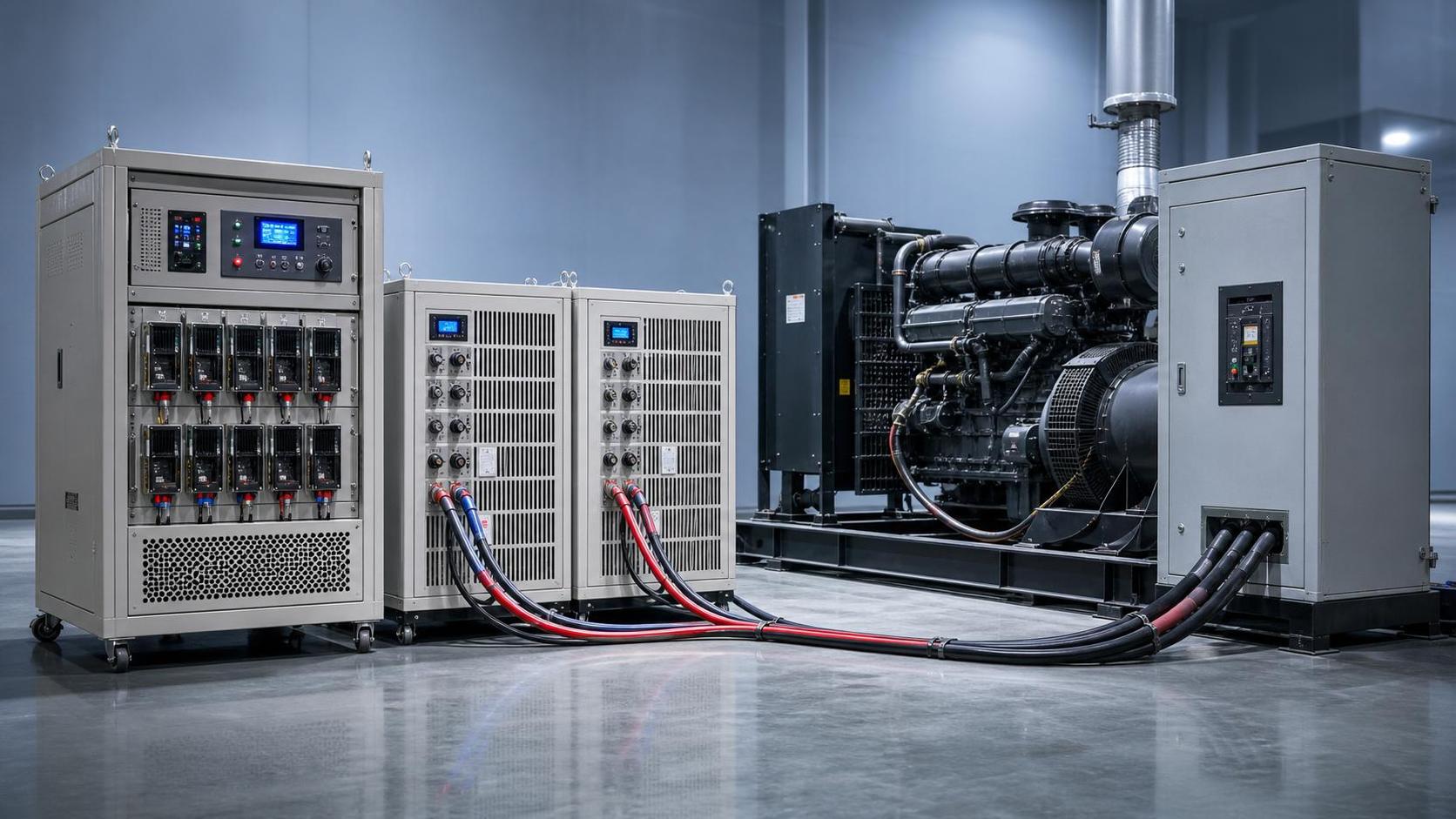
Generator commissioning becomes clearer when the test scenario is defined early
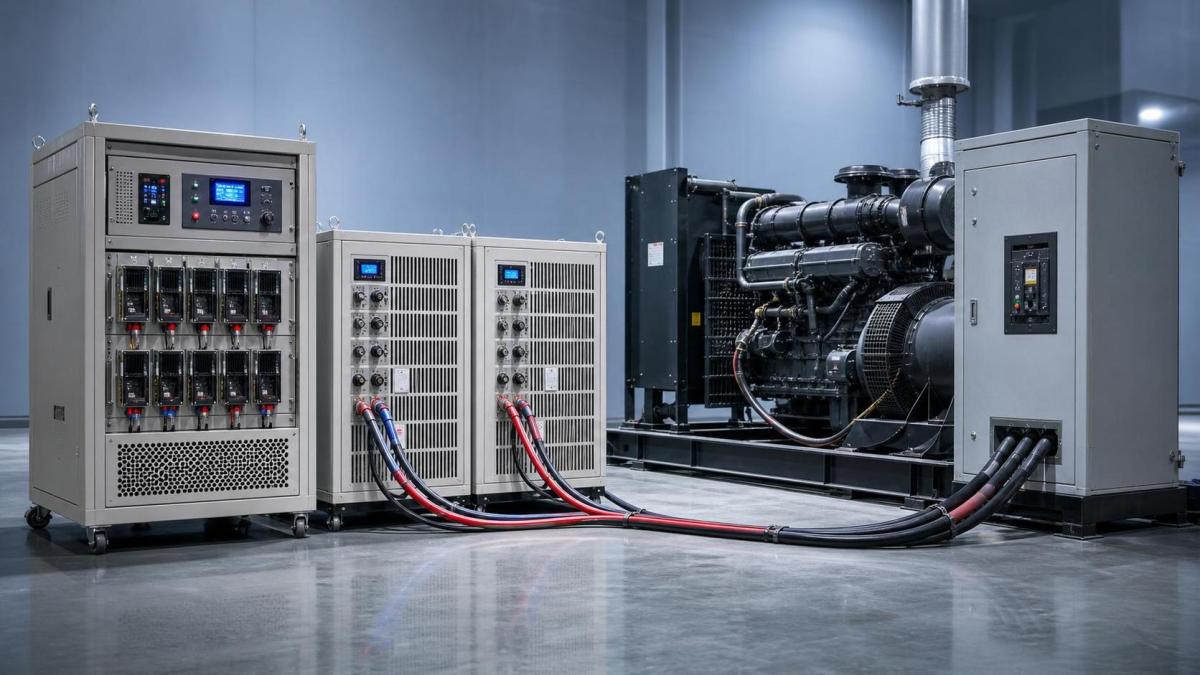
An AC Load Bank is rarely a last-minute accessory in generator commissioning.
It is usually the tool that proves whether the installed system can carry real operating demand without unstable voltage, frequency drift, or hidden thermal stress.
That matters because commissioning is not only about starting the generator.
It is about verifying rated output, control response, protection behavior, and handover readiness under controlled electrical load.
In practice, the question is not simply whether to test.
The more useful question is when an AC Load Bank should be introduced, at what load profile, and under which site conditions.
Different projects answer that differently.
A standby diesel set in a hospital, a data center backup line, and a mobile temporary power unit may all need load testing, but not for the same reasons.
That is where resistive and related electrical testing solutions become relevant.
A well-matched AC Load Bank, whether portable, rack mounted, electronic, or liquid cooled, helps turn electrical assumptions into measurable evidence.
Actual commissioning needs vary because field conditions are never identical
Two generator systems with the same nameplate can behave very differently during commissioning.
Cable length, altitude, cooling airflow, fuel quality, governor tuning, and switchgear coordination all affect the test result.
The connected facility also changes the purpose of the AC Load Bank test.
Sometimes the priority is proving continuous kW output.
In other cases, the focus is step-load response, transient stability, or confirming that wet stacking risks are removed before long standby periods.
Projects linked with capacitive correction equipment or grounding resistor cabinets may add another layer of checking.
The generator itself might pass, while system integration still shows imbalance, poor neutral management, or uneven phase loading.
That is why an AC Load Bank should be considered as part of the electrical validation strategy, not only as a rented test box at the end.
New installation handover is the most common point to use an AC Load Bank
For a newly installed generator, the AC Load Bank usually enters the process before the final handover document is signed.
At this stage, the main need is confirmation.
Can the unit carry staged load, hold rated voltage, and maintain acceptable frequency under rising demand?
A resistive AC Load Bank is often preferred here because it applies predictable, stable load without depending on the building’s live circuits.
That makes it easier to isolate generator performance from unrelated site variables.
The most useful approach is usually staged loading.
Typical checkpoints include 25%, 50%, 75%, and full rated load, with dwell time at each point.
This reveals temperature rise, exhaust behavior, AVR regulation, and cooling reserve more clearly than a short no-load start test.
Portable load banks are often selected on tight construction sites.
Where the commissioning room is compact, rack mounted or electronic load bank arrangements may fit better into the testing workflow.
What matters most during first-time validation
- Stable load steps that match generator rating and phase configuration.
- Adequate ventilation around the AC Load Bank and generator room.
- Verified cable sizing, connection points, and protection settings.
- Test records covering voltage, frequency, current, and temperature trends.
Commissioning after overhaul or control upgrades needs a different test focus
The decision to use an AC Load Bank is just as important after engine overhaul, alternator repair, or governor and AVR replacement.
In these cases, the generator has a service history, but the commissioning risk is still real.
A repaired system may start normally and still fail when the load rises sharply.
Here, the AC Load Bank is less about proving nominal capacity from zero.
It is more about confirming that the repaired control loop responds correctly and does not hunt, overshoot, or trip unexpectedly.
Step changes and short-duration peaks are often more valuable than a simple long steady run.
This is also where electronic load bank configurations can help if finer load adjustment is required.
When a site uses capacitor bank equipment downstream, it is worth separating generator acceptance from power factor correction behavior first.
That avoids blaming the generator for a switching issue elsewhere in the electrical chain.
Facilities with low natural load often rely on an AC Load Bank more than expected
Some standby generators are oversized for the actual building load during early operation.
This is common in phased developments, new data halls, infrastructure projects, and utility support sites.
The generator may be commissioned before the facility reaches meaningful demand.
Without an AC Load Bank, the test can become misleading.
The unit appears operational, yet critical behavior at higher load remains unknown.
This is also where resistive loading helps reduce wet stacking concerns in diesel sets that would otherwise idle or run lightly loaded for long periods.
Liquid cooling load bank designs may be considered when space, heat rejection, or noise management is difficult.
The key judgment is whether the site load can truly challenge the generator.
If it cannot, the AC Load Bank should not be delayed.
Different commissioning conditions lead to different testing priorities
Temporary power and remote deployment call for faster, more practical AC Load Bank choices
Not every generator commissioning project happens in a finished plant room.
Construction power, event backup, telecom support, and emergency rental fleets often work in changing environments.
In these cases, an AC Load Bank is used because field uncertainty is higher.
Cabling may be longer, ambient temperature may vary sharply, and the final connected load may not be available during the test window.
Portable load bank designs are often the practical fit here.
The selection priority shifts toward transport, setup speed, weather tolerance, and clear operator control.
The testing target also changes.
Instead of full documentation depth, the immediate goal may be field readiness and confidence that the generator will accept duty without unstable response.
Common misjudgments usually come from treating all generator tests as the same
A frequent mistake is choosing an AC Load Bank only by kW rating.
That misses voltage class, phase arrangement, duty cycle, cooling method, and available connection space.
Another common issue is assuming the site’s own load is enough for commissioning.
In reality, many connected loads are too variable, too sensitive, or simply too small for a reliable proof test.
Some projects also overlook heat management.
A resistive AC Load Bank converts electrical energy into heat, so airflow planning is not optional.
On tighter sites, that may be the reason to consider liquid cooled solutions instead of conventional open-air units.
There is also a systems-level blind spot.
When grounding resistor cabinets, capacitor bank switching, or battery-backed controls are part of the installation, generator behavior should be read together with those interfaces.
Otherwise, the final report may confirm the machine while missing a broader commissioning risk.
Useful checks before the test begins
- Match the AC Load Bank voltage, phase, frequency, and duty rating to the generator.
- Confirm whether the goal is endurance, step-load response, or low-load conditioning.
- Review site ventilation, cable routing, noise limits, and safety clearance.
- Separate generator issues from downstream capacitor or switchgear behavior where possible.
- Record baseline values before adding load, not only after reaching the target.
A practical way to decide when an AC Load Bank should be part of commissioning
A simple rule works well in the field.
Use an AC Load Bank when the installed load cannot fully validate the generator, when the electrical system has been materially changed, or when compliance evidence must be documented before service begins.
That covers most commissioning situations where hidden performance gaps would be expensive later.
The best next step is to map the real operating scenario first.
Check expected load level, duration, environmental limits, space, and interaction with related electrical equipment.
Then choose the AC Load Bank format that fits the test objective rather than forcing one standard method onto every project.
That approach produces better commissioning data, fewer handover surprises, and a generator system that enters service with verified electrical confidence.




Please give us a message
