

Related content
- Oct 07, 2026Sunwin Aerospace Power System Testing SolutionAn aerospace power system generates, stores, converts, regulates and distributes electrical energy, and is typically divided into primary power and secondary power. Secondary power converts primary power into another form or specification to meet the requirements of different onboard electrical equipment. As an essential support system, the aerospace power system provides safe and reliable energy for every subsystem of aircraft and spacecraft, and its development level plays a decisive role in improving aircraft performance and extending service life.
From 28Vdc, 270Vdc to 400Hz AC supplies, power quality directly affects the safe operation of onboard equipment. International aerospace power quality standards such as MIL-STD-704 and RTCA DO-160 impose strict requirements on voltage, frequency and transient characteristics. Therefore, comprehensive testing and evaluation of the power system under defined operating conditions is of great significance. - Oct 06, 2026Sunwin Advantages Technology, Products and Service — A Trusted Partner in Power TestingWith leading liquid-cooling technology, a complete product portfolio, precise real-working-condition simulation, one-stop solutions, international quality certification and a customer-first service philosophy, Sunwin will continue to safeguard the safety and reliability of power systems and AI computing infrastructure worldwide. Contact us and start a trustworthy partnership in power testing today.
- Oct 04, 2026Why Sunwin? Your Professional Partner in Power Testing & MeasurementQingdao Sunwin Technologies Co., Ltd. (Sunwin) is a professional enterprise dedicated to the R&D, manufacturing and service of intelligent power testing equipment. Built on load banks, Sunwin provides testing systems and intelligent test equipment for the generation, transmission, transformation, control and utilization of electrical energy.
A load bank is a power testing device that simulates real operating conditions (a dummy load). It reproduces the load characteristics of power equipment through resistive, inductive and other elements, enabling testing, adjustment, calibration and verification of generator sets, UPS, batteries and other power sources without connecting them to real loads. With advanced load testing technology, Sunwin helps customers scientifically verify the performance and reliability of power equipment, improve quality control and reduce safety accidents and economic losses caused by power failures. - Oct 03, 2026Sunwin WN-6000L 6000kVA Resistive-Inductive Load BankThe Sunwin WN-6000L is a 6000kVA high-power resistive-inductive (R/L) load bank developed by Qingdao Sunwin Technologies Co., Ltd. (Sunwin). Designed for generator load bank testing, UPS load bank testing, data center load testing and power-system tests, it delivers controlled active and lagging reactive loading to fully meet high-power equipment load-verification requirements.
Built on the core principle of "resistive-inductive integration", the WN-6000L combines 4800kW active load with 3600kVar inductive reactive load at 0.8 lagging power factor, accurately reproducing the real operating conditions of generator sets and UPS systems. It helps customers fully verify load capacity and reliability during factory acceptance, grid-connection testing and routine maintenance.
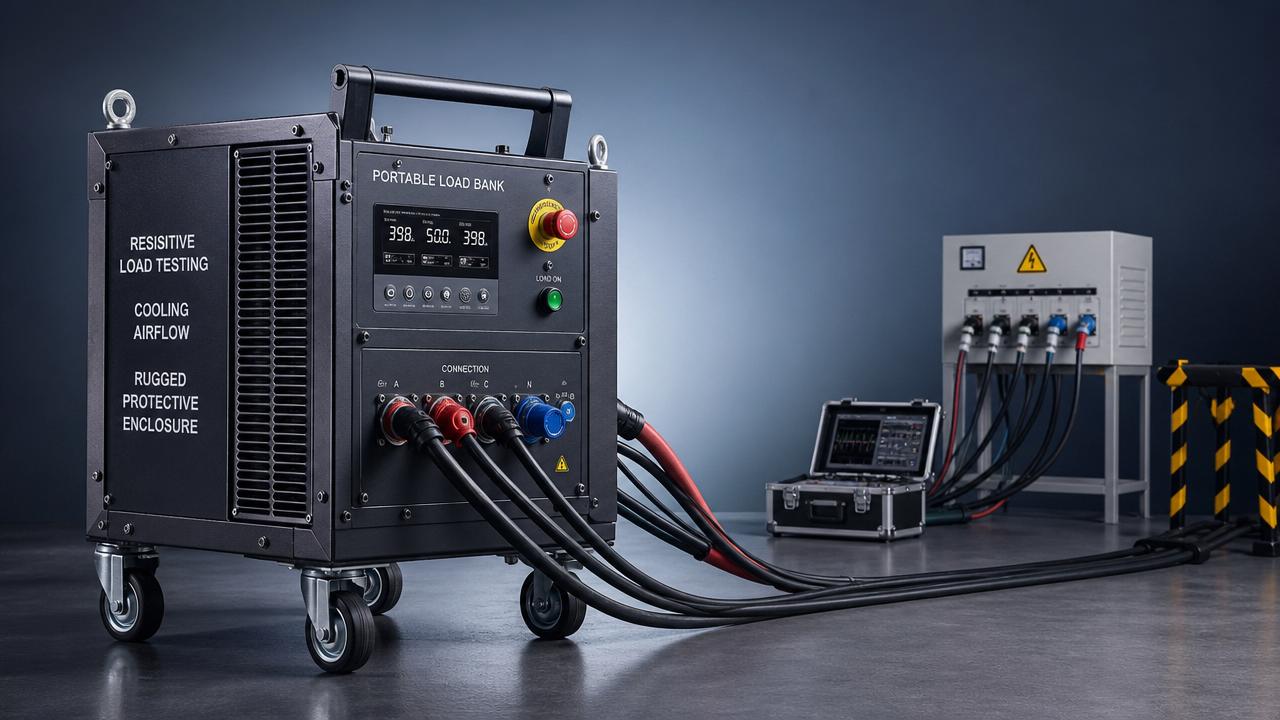
For quality control and safety work in temporary power environments, a Portable Load Bank must do more than apply electrical load. It must reduce exposure to heat, unstable connections, operator error, and changing site conditions. A safer unit combines predictable resistive load control, effective cooling, strong enclosure protection, and clear status feedback. These features matter during commissioning, maintenance, generator testing, UPS verification, and battery discharge work.
Why a checklist matters when judging Portable Load Bank safety
Field testing often happens around dust, rain, uneven surfaces, cable traffic, and limited supervision. In these conditions, small design weaknesses can create major electrical or thermal hazards.
A checklist helps compare units using practical safety points instead of only rated kW. It also supports more consistent acceptance decisions across different sites and power system tasks.
Because a Portable Load Bank belongs to the resistive and capacitive power test field, safe design must address resistor performance, heat flow, insulation spacing, control stability, and discharge behavior.
Core safety checklist for a Portable Load Bank
- Verify stepped or continuous load control that stays stable during voltage changes, preventing sudden current spikes, nuisance trips, and unsafe stress on connected generators, UPS systems, or battery circuits.
- Check high-efficiency cooling design with balanced airflow, protected fans, and thermal separation, so resistor elements maintain safe temperatures even during long-duration field tests in hot weather.
- Confirm over-temperature protection at resistor banks and exhaust zones, with automatic load shedding or shutdown functions that act before enclosure surfaces or internal conductors reach dangerous levels.
- Inspect enclosure strength, corrosion resistance, and ingress protection, ensuring the Portable Load Bank tolerates transport shock, dust exposure, light rain, and accidental contact in outdoor operation.
- Require clear cable entry layout and secure terminal protection, reducing the chance of loose connections, phase mistakes, exposed live parts, or forced cable bending near hot sections.
- Look for emergency stop access and intuitive control labeling, allowing quick response when abnormal noise, smoke, airflow blockage, or unstable source behavior appears on site.
- Review grounding design carefully, including dedicated earth terminals and continuity protection, because poor bonding can make a Portable Load Bank unsafe even when load values seem normal.
- Check real-time monitoring for voltage, current, power, temperature, and fault status, since visible data helps detect unsafe drift before resistor overheating or source instability develops.
- Confirm transport safety features such as lifting handles, wheel locks, balanced center of gravity, and anti-tip structure, especially when the unit must move across rough or narrow job areas.
- Ask whether resistor materials and internal components are selected for repeated thermal cycling, because fatigue cracking and insulation aging often begin after frequent field deployment.
Key design features that make field operation safer
Reliable resistive load architecture
A safer Portable Load Bank uses resistor elements with uniform heat distribution and predictable resistance values. Stable resistive behavior reduces local hot spots and avoids unexpected load imbalance.
In battery discharge or generator acceptance tests, load steps should engage smoothly. Contactors, solid-state switching, and control logic must prevent arcing, bounce, or delayed release.
Effective thermal management
Heat is the main safety challenge in any Portable Load Bank. Good designs separate intake and exhaust paths, shield touchable surfaces, and keep airflow away from cable connection points.
Thermal sensors should cover more than one point. Monitoring only one resistor zone may miss blocked airflow, fan failure, or uneven internal heating during partial-load operation.
Clear monitoring and alarms
Simple interfaces improve safety. Operators need visible values, alarm codes, running status, and fault history without opening the enclosure or using temporary measurement workarounds.
When a Portable Load Bank includes remote monitoring, cable management and signal integrity become important. Reliable communication helps maintain distance from hot equipment and energized conductors.
Durable enclosure and isolation details
Outdoor-ready housings should resist deformation, corrosion, and vibration. Internal spacing, insulation barriers, and guarded openings matter as much as external metal thickness.
In equipment linked with capacitor bank systems or power factor correction cabinets nearby, electromagnetic noise and switching transients can appear. Strong internal isolation helps preserve control stability.
Safety differences across common applications
Generator commissioning
During generator tests, a Portable Load Bank must tolerate voltage fluctuation and frequency drift. Load steps should remain controlled when the source is still stabilizing.
Exhaust orientation is critical near fuel systems and service pathways. A poor layout can heat nearby equipment, damage cables, or create unsafe working zones.
UPS and data backup validation
UPS testing often occurs indoors where ventilation is limited. Here, low-noise fans, predictable airflow, and accurate metering become major safety factors.
A Portable Load Bank for UPS work should also support controlled load increments. Sudden changes can trigger transfer events or mask actual system weakness.
Battery discharge testing
Battery applications require special care because current can stay high while voltage falls. The Portable Load Bank should maintain stable discharge behavior and protect against over-discharge conditions.
If electronics load control is included, heat management and cutoff logic must be proven. Battery testing faults can develop slowly, then become severe very quickly.
Commonly overlooked risks
Ignoring cable temperature rise. Safe resistor performance means little if undersized cables or poor lugs overheat first. Connection hardware must match full current and duty cycle.
Assuming all emergency stops are equal. Some devices stop controls but do not immediately remove load. Confirm how the shutdown sequence actually behaves under fault conditions.
Overlooking fan power dependency. If cooling fans rely on a separate supply, loss of that supply can leave a Portable Load Bank energized without proper airflow.
Missing post-test cooling time. Internal resistor elements may stay hot after current drops to zero. Moving or covering the unit too early can damage parts or injure personnel.
Neglecting grounding continuity after transport. Frequent movement can loosen hardware. A quick earth continuity check should be routine before every deployment.
Practical execution advice before field use
- Match the Portable Load Bank rating to real test voltage, current, duration, and ambient temperature instead of relying only on nameplate kW.
- Walk the site first, checking ventilation path, exhaust clearance, cable routing, trip hazards, and weather exposure before energizing the unit.
- Run a no-load functional check for fans, controls, alarms, meters, and emergency stop response before applying full resistive load.
- Increase load in planned steps and monitor temperature trend, not only final values, because unsafe drift often appears before any trip occurs.
- Record fault events, cooling behavior, and connection conditions after each test to identify repeat issues and support safer future deployment.
Conclusion and next action
What makes a Portable Load Bank safer for field use is not one feature alone. Safety comes from coordinated resistor design, cooling performance, enclosure durability, grounding integrity, and visible control feedback.
A practical review should compare thermal protection, load stability, ingress resistance, monitoring depth, and transport details under the exact application conditions expected on site.
Sunwin focuses on resistive load bank, rack mounted load bank, electronics load bank, liquid cooling load bank, Portable Load Bank, battery load tester, grounding resistor cabinet, and capacitor bank solutions. Start with a field-safety checklist, confirm test parameters, and select a unit built for repeatable, controlled, and safer operation.


Please give us a message
