

Related content
- Oct 12, 2026Rack Mounted Load Bank Sizing for Data Center Rack Density and AirflowSize your Sunwin Rack Mounted Load Bank for data center rack density and airflow. Learn how voltage, load steps, and cooling capacity affect selection for reliable commissioning.
- Oct 07, 2026Sunwin Aerospace Power System Testing SolutionAn aerospace power system generates, stores, converts, regulates and distributes electrical energy, and is typically divided into primary power and secondary power. Secondary power converts primary power into another form or specification to meet the requirements of different onboard electrical equipment. As an essential support system, the aerospace power system provides safe and reliable energy for every subsystem of aircraft and spacecraft, and its development level plays a decisive role in improving aircraft performance and extending service life.
From 28Vdc, 270Vdc to 400Hz AC supplies, power quality directly affects the safe operation of onboard equipment. International aerospace power quality standards such as MIL-STD-704 and RTCA DO-160 impose strict requirements on voltage, frequency and transient characteristics. Therefore, comprehensive testing and evaluation of the power system under defined operating conditions is of great significance. - Oct 06, 2026Sunwin Advantages Technology, Products and Service — A Trusted Partner in Power TestingWith leading liquid-cooling technology, a complete product portfolio, precise real-working-condition simulation, one-stop solutions, international quality certification and a customer-first service philosophy, Sunwin will continue to safeguard the safety and reliability of power systems and AI computing infrastructure worldwide. Contact us and start a trustworthy partnership in power testing today.
- Oct 04, 2026Why Sunwin? Your Professional Partner in Power Testing & MeasurementQingdao Sunwin Technologies Co., Ltd. (Sunwin) is a professional enterprise dedicated to the R&D, manufacturing and service of intelligent power testing equipment. Built on load banks, Sunwin provides testing systems and intelligent test equipment for the generation, transmission, transformation, control and utilization of electrical energy.
A load bank is a power testing device that simulates real operating conditions (a dummy load). It reproduces the load characteristics of power equipment through resistive, inductive and other elements, enabling testing, adjustment, calibration and verification of generator sets, UPS, batteries and other power sources without connecting them to real loads. With advanced load testing technology, Sunwin helps customers scientifically verify the performance and reliability of power equipment, improve quality control and reduce safety accidents and economic losses caused by power failures.
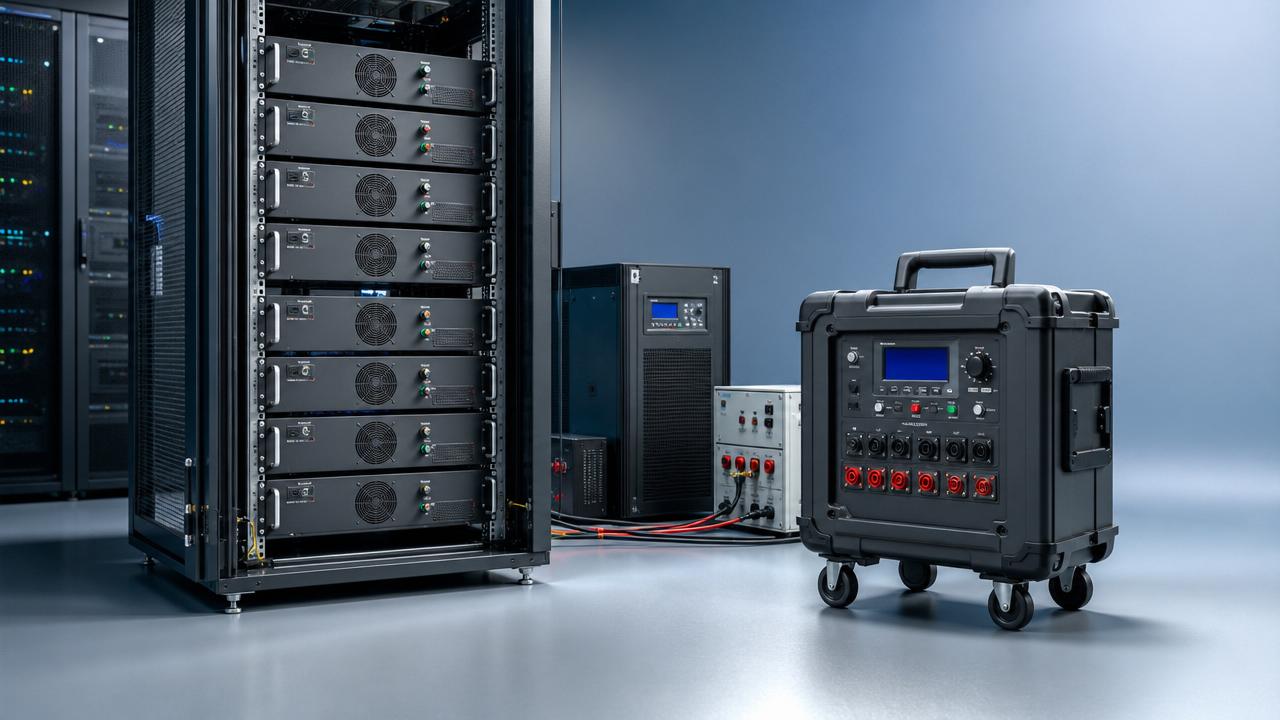
Choosing between a Rack Mounted Load Bank and a portable load bank can shape testing speed, deployment flexibility, and lifecycle cost. In resistive and capacitive power systems, the best choice depends on where testing happens, how often it repeats, and how stable the installation must remain.
A well-matched load bank supports reliable commissioning, maintenance verification, battery discharge testing, generator validation, and data center power checks. This comparison explains where a Rack Mounted Load Bank performs better, where portable solutions win, and how to decide with fewer risks.
When fixed-site testing favors a Rack Mounted Load Bank
A Rack Mounted Load Bank fits best when testing happens repeatedly in one controlled location. Typical examples include labs, telecom rooms, UPS stations, battery rooms, server facilities, and power equipment test benches.
In these environments, operators value stable installation, cleaner cable routing, and easier integration with monitoring systems. Rack mounting also helps organize resistive load modules and related control components inside standard cabinet infrastructure.
Best-fit signs for fixed installations
- Testing is scheduled weekly, monthly, or continuously.
- The site already uses racks, panels, and structured power distribution.
- Remote data collection or automated control is required.
- Airflow, ventilation, and safety zoning are already designed.
- The project needs neat integration with UPS, battery, or capacitor bank systems.
For repeatable testing, a Rack Mounted Load Bank usually improves consistency. Fixed wiring reduces setup errors. Dedicated controls simplify operation. Maintenance teams can verify performance faster because the system remains in place.
When mobile field work makes portable load banks more practical
Portable load banks are stronger in changing locations. They are commonly used for temporary site acceptance, emergency generator tests, marine service visits, rental fleets, and projects spread across several facilities.
If the test team must move between buildings or remote installations, portability can save major labor time. Instead of building a permanent station, one mobile unit can support many assets across different sites.
Best-fit signs for portable solutions
- Testing frequency is low at each location.
- Equipment is distributed across multiple facilities.
- The site cannot allocate rack space permanently.
- Rapid deployment matters more than system integration.
- Load testing must support temporary projects or service contracts.
Portable models often trade integration depth for mobility. They may require manual cabling each time. That extra setup is acceptable when location flexibility matters more than a fixed, optimized workflow.
Which applications usually choose Rack Mounted Load Bank systems?
Some applications naturally benefit from a Rack Mounted Load Bank because testing is part of normal infrastructure management. The equipment becomes a long-term tool, not a temporary accessory.
UPS and battery backup verification
Battery discharge testing often requires controlled, repeatable resistive loading. A Rack Mounted Load Bank supports stable connection paths, easier logging, and regular maintenance routines inside battery or UPS environments.
Data center and server room testing
Data centers prefer equipment that fits cabinet-based layouts. Rack-mounted solutions align with structured airflow, organized access, and integrated monitoring. They are especially useful for recurring validation of backup power systems.
Power electronics and capacitor-related lab validation
In resistor and capacitor industries, labs often test converters, discharge circuits, grounding systems, and energy storage modules. A Rack Mounted Load Bank offers clean installation for controlled development work.
Integrated industrial test benches
Factories using repeat process validation usually favor permanent setups. Load banks mounted in racks reduce cable clutter and help standardize test conditions across production or service cycles.
How the two options differ across real project needs
The decision becomes clearer when comparing the actual demands behind each project. The table below highlights where a Rack Mounted Load Bank or portable load bank delivers stronger value.
How to match the load bank to your operating environment
The smartest choice comes from environmental fit, not just nameplate capacity. A Rack Mounted Load Bank may look ideal on paper, yet mobility demands can make portable equipment more efficient overall.
Choose Rack Mounted Load Bank if these conditions apply
- You run recurring battery, UPS, or power system tests.
- The installation site has available rack capacity.
- Control, monitoring, and safety interlocks must be integrated.
- You want stable, documented testing procedures.
- You need cleaner infrastructure for resistor-based load management.
Choose portable load bank if these conditions apply
- You test equipment at multiple locations.
- The project is temporary or short-term.
- Permanent installation is not approved or practical.
- Transportability matters more than cabinet integration.
- One unit must serve varied field conditions.
Common mistakes when comparing Rack Mounted Load Bank and portable options
Selection errors usually happen when teams compare only rated power. Real performance depends on workflow, thermal conditions, electrical interfaces, and service planning. Several common oversights can lead to poor fit.
Ignoring installation time over the product lifecycle
A portable unit may cost less initially, yet repeated transport and setup can raise total operating cost. A Rack Mounted Load Bank often saves labor in long-term testing programs.
Underestimating cooling and airflow needs
Resistive load equipment produces heat. Rack systems need planned ventilation. Portable units need safe positioning on each site. Ignoring thermal design reduces reliability and affects test accuracy.
Overlooking data and control expectations
If the project needs trend logging, automation, or integration with facility control, a Rack Mounted Load Bank usually provides a better path. Temporary devices may require extra instruments.
Choosing based on space, not use case
Small size alone should not decide the purchase. A compact portable unit can still slow operations if constant movement is unnecessary. The right fit comes from usage pattern first.
A practical next step for choosing the better load bank
Start by listing three factors: testing frequency, number of sites, and required integration level. That simple review usually reveals whether a Rack Mounted Load Bank or portable load bank fits better.
For fixed battery rooms, UPS systems, labs, and cabinet-based power infrastructure, a Rack Mounted Load Bank often delivers stronger control, cleaner installation, and lower long-term effort. For remote, changing, or temporary jobs, portable load banks remain the more flexible choice.
Sunwin focuses on resistive load bank solutions, including Rack Mounted Load Bank, portable load bank, electronics load bank, liquid cooling load bank, battery load tester, grounding resistor cabinet, and capacitor bank products. Matching the right format to the right scenario helps achieve safer testing, better efficiency, and more reliable power validation.


Please give us a message
